|
A few months ago, the BBC website published an article entitled
How Too Much Mindfulness Can Spike Anxiety 1. In the article, the author-practitioner writes of his increasingly uncontrollable
anxiety as a result of his practice. He does not mention the meditation technique, but
one may presume from his description that it is either Satipatthana or
Vipassana Buddhist meditation. These ancient methods are both reliable and
safe, and they are recommended for anyone wishing to start meditation practices in order
to help calm a troubled mind and develop the power of attention.
The problem the practitioner has encountered after some time is that “Rather than
relaxing, my heart would begin to accelerate, or my inner monologue would take a nasty
turn, as unpleasant memories and feelings of failure and hopelessness flooded my mind.
These events became so frequent that I now only use mindfulness occasionally.”
The article then goes on to describe the experience of others who felt “that they no
longer feel extreme joy or happiness. In extreme cases, this can result in the
unsettling sense of ‘disassociation’ from their life.”
One authority quoted, an assistant professor in psychiatry and human behaviour at Brown
University, USA, who stated that “Similar to attention-enhancing drugs like coffee,
Ritalin and cocaine, meditation can increase focus and alertness, but when taken too far
that can lead to anxiety, panic and insomnia, because there is both neuroanatomical and
neurochemical overlap between attention and arousal systems in the brain. You can only
crank up your attention dial so far before you start feeling anxious or stop sleeping.”
It is clear from these statements that there is a genuine problem here for some people
and this editorial tries to address it.
All the various traditional schools of Yoga are safe if practised according to the
guidelines set in place. The question is what school of Yoga is right for a specific
individual. To give an extended metaphor: In athletics there are all types of games and
competitions. The muscles required by a 100 metre sprinter are different from those who
run a marathon. A swimmer does not have the same muscle composition as a track and field
athlete.
Similarly, on the spiritual path, there are specific requirements and training practices
for the aspirant. A person who is highly emotional would be better suited to a path
where those emotions are challenged in such a way as to transform them in a positive
direction. Bhakti Yoga would be suitable in this case. A person who is
identified intensely with their body would be well advised to practise
Hatha Yoga. By stretching their muscles, the tensions that accumulated in the
body would slowly but surely be relaxed and the bandus (psychic knots) in the
various parts of the body are freed of accrued negativity. This allows the person to
focus their mind much more easily.
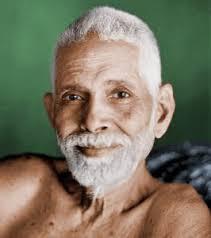
The path espoused by Bhagawan Sri Ramana Maharshi is jñāna yoga. This path
encompasses all the other paths as stepping stones to the final practise of
ātma-vicāra, ‘Who Am I?’
Bhagawan encouraged all who practised mantra, Pranayama, vedic
rituals, temple worship, and any other legitimate practice to continue their
observances. Why? Because he understood that each person is on their own unique path and
that is their prārabdha, (destiny). Bhagawan was not interested in creating an
army of robotic souls who marched to the same tune. He did not believe in uniforms,
proselytizing or creating powerful organizations with numerous participants.
If a person comes to Bhagawan with a sincere heart, slowly like water trickling along
rugged terrain, the devotee will find a route to the destination. Within all our
apparatus of mind, heart, body, 2 there is what one
could call a magnetic device. Much like those amazing geese who fly thousands of miles
in one uninterrupted journey to a destination with the aid of an internal compass, we
too have a similar device. Some may call it a conscience, others identify it as
buddhi (higher mind). In each of us is an ability to attune ourselves to a
higher purpose. The Christians objectify it as an angel who whispers in our ear.
Inevitably when we meditate, unpleasant memories and painful thoughts will arise. It is
natural as we face our unresolved fears and desires. Let us again use the metaphor of
the athlete. If someone wants to be physically fit, they perform regular exercise to
stretch and strengthen the muscles of the body. The muscles become supple and can
quickly recover from an exertion or say a fall that may otherwise incapacitate a person
who has not exercised and whose body is stiff. An athlete can become fit by running
around a field track endlessly but not actually going anywhere. Likewise, a person can
follow a meditation procedure and get the expected result again and again, but no more,
no less.
There is a famous statement from the 1960s by Marshall McLuhan, a Canadian philosopher.
He stated, “The medium is the message.” One interpretation simply put, is that it
implies that according to the medium you will get a particular result. If, say, for
example, a person performs kundalini yoga and does it right, sooner or later,
psychic experiences connected with the kundalini chakras will manifest. A
person who worships Lord Krishna will, eventually according to the intensity of their
practice, see a vision of Lord Krishna or something directly related to this deity.
Maybe the problem of despondency encountered by the writer and others in the article
referred to at the outset, is that he has not extended himself beyond the limits of who
he thinks he is. He endlessly follows a formula and does not look beyond it. It is
similar to taking a painkiller for an illness but not addressing the cause. Instead of
launching beyond the narrow confines of his conditioned mind, he repeats the mental
exercise and fails to follow through on the implications of why he is doing it.
Who would not feel dispirited if they continually ran around a track or repeated the
same meditation exercises with no obvious positive result? There is no joy in sitting
for hours watching the breath or the mind if there is no breakthrough away from the
tired old obstructive habits and memories. We are required to be patient, but to the
degree of our aspiration for a higher ideal or purpose with our life. With the momentum
we generate, we will one day burst through in elation. Here devotion is paramount.
Devotion to something greater than oneself: a universal ideal, a saintly sage, a loving,
wise deity, a worthy cause. Devotion is the energetic delight, the refreshing taste that
makes the food of experience enjoyable.
It is here that we need to understand a very important point. We not only need to purify
our minds and hearts with spiritual practices but we also require a will
(icchā). There are times when nothing we do or say appears to make the
slightest bit of difference to our ignorance or pain. In the face of apparently
overwhelming odds and confusion, we must energise our will to overcome the challenge,
whatever the cost. It is not pretty. In fact, at times it is quite ugly as we fight our
way out of insupportable situations and an apparently insoluble dilemma in our own mind.
Like Arjuna in the battlefield facing his relatives or in our interpretation, our
vāsanās and saṁskāras, we cannot retreat but must fight to preserve
our integrity. It is not a question of triumphing but rather of fighting per se, for in
the end there are no winners. Everyone pays a price. The question is: is it worth it? If
it frees you from a chain of blind ignorance and complacent acquiescence, then yes.
There is a famous quote attributed variously to several historical personages: “I'd
rather die on my feet than live on my knees.” This should be our attitude as we enter
the spiritual path. In other words, in our case, no compromise with untruth; that we
should follow our swadharma, our specific allotted path. However one hastens to
add that it does not make it justifiable to be rigid and harsh to others. Quite the
contrary. Through our own travails, we develop compassion for others who are suffering.
A sharp intellect, a tender heart.
We can look to Arjuna who was paralyzed at Kurukshetra before the battle. He did not
want to fight, much the same way we do not want to fight but when there is no choice but
to do our duty to ourselves, we do fight. We do it every day when we wake up as negative
thoughts and habits spring up and try to influence our choice of thought and action.
The practitioner that we mentioned at the beginning of the editorial observes that
meditation after years of practice does not bring him peace but anxiety and he has
ceased to feel any joy. Instead of creating flexibility, the meditation has fashioned a
fixed sense of objectivity, an instrument of neutral witnessing that has separated him
from life. He feels ‘alienated’. Such a practitioner has divided him or herself into two
and as a consequence feels empty and without meaning.
This is a normal stage of development in meditation. Until such time as we develop
discrimination, we endure a laborious education honing our mental strength so as not to
be sucked into transitory desires and not to be intimidated by the usually illusionary
fears, or if they are real enough, gather the courage to face them down. This split
between an observer (our sense of who we think we are) and an observed (our thoughts and
feelings) can take years of refinement, until we can consciously let go and trust the
spontaneous outpouring (sphuraṇa) that comes from the heart in either the form
of subtle thoughts or feelings. In spiritual literature, through the ages, it is
generally referred to as the ‘dry period’ or ‘the journey across the desert’.
Finally, the writer mentions that if the attention is cranked up too far it is
dangerous. We would agree with this. This is a major challenge. We have seen it in the
ashram people who go too far too quickly without establishing their purity of
mind and heart, and equanimity properly.
However, we often see those who come for a short time spend an inordinate, intense
amount of time in the Old Hall or walking round the hill at all hours. We could say, to
extend the sports analogy, they are running a 100 metre dash. We should remember that
those who are so intense, their time is limited and for the rest of the year they
survive on the blessings received in that narrow window. A type of feast and famine.
When what they received has been absorbed correctly they are ready to come again.
For those who are here much of the year, they are running a marathon and as a
consequence their pace is slower and more methodical. Patience is essential for there
are times when nothing seems to happen and one is bored and frustrated. It is a phase
that will pass as one’s physical and subtle bodies adjust to the spiritual practices
which ejected the negative samskaras lurking in the bandus on the
nervous system and nadis. Physical illness is a common, normal result of the
expulsion of the mental and emotional dirt.
For those who are at the ashram more regularly, there is the challenge of how open and
concentrated one can be to receive the divine grace. Again, an analogy. We all live on
various types of food. There is gross food that we eat two or three times a day to
maintain our energy-levels and body. There is subtle emotional food when we communicate
on a deep level with a friend or listen to say, inspiring music or hear the Vedic
chanting. There is mental food when we exchange stirring ideas and gain a rare insight.
Or it might be a book that contains a profound perception that buoys us up throughout
the day. Like any type of food, Bhagawan’s Grace cannot be endlessly ingested. There is
a time when we have to go away and integrate that invisible ‘heart to heart’
communication. Those who continue to stuff themselves regardless of whether they are
hungry or not will suffer severe spiritual indigestion. In rare cases it can unbalance
them, sometimes permanently.
Bhagawan may appear to be a sweet old man ready and willing to hand out sweets but this
is but part of the picture. Bhagawan is also a fiery tiger who will burn any falsehood
mercilessly. Bhagawan’s brother would at times advise people who first came to the
ashram during Bhagawan’s lifetime, “Be careful. He is Siva. He is fire!”
|

 Home
Home
 Home
Home Previous
Article
Previous
Article