|
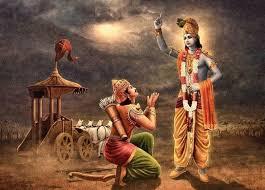
Shri Krishna asked Arjuna to fight the Battle of Kurukshetra as that was the
Kshatriya Dharma (duty of a Kshatriya) and dedicate all actions and results to
Bhagawan, as the latter was the cause of every action, the causation or the basis of
action and the causer or the creator of the cause. Bhagawan defined that out of the
Eighteen Adhyayas (Chapters) of the Bhagawad Gita, five
Adhyayas constituted five of His faces, five Adhyayas his ten hands,
one Adhyaya was his belly, and two were his feet. The Padma Purana assured that
intelligent persons who read one Adhyaya of Gita a day, or half of it, or a
quarter of it or even a stanza at least would pave way to mukti and cited the
example of Susharma who was no doubt a brahmin but a chronic sinner; he did
neither dhyana nor japa nor even atithi seva or service to
guests; on the other hand, he was a drunkard, meat-eater and a womaniser. One day, he
died of a snakebite and after suffering several narakas and births as the
retribution of his sins, was born as a bull and served under an oil extractor for many
years and died of hard work and exhaustion. A few kind persons contributed and prayed
for its salvation and among them was a veshya (prostitute) who donated some
punya on her account. In the rebirth the bull was born as a brahmin in the same
village as a jatismara or with the memory of the previous birth. He located the
veshya and asked her as to which punya she donated to the dead bull.
She said that she bought a parrot which used to mutter a stanza and that gave a soothing
effect. The brahmin learnt from his powers that the parrot learnt the stanza
from the cage in which a rishi stayed in his ashram but a hunter stole the
parrot and sold it to the veshya. On reaching the rishi, the
brahmin was told that the stanza that the parrot learnt was from the first
chapter of the Gita!
A Vedic pandit, Deva Shyam of Purandarapura of Dakshina Bharata was anxious to learn
tatwa gyana and approached a mahatma (great learned person) in this
connection. The mahatma directed the pandit to a goat keeper called Mitravan in
a forest who was seated on a rock on the banks of a riverbed nearby. Mitravan narrated
to Deva Shyam about his experience of a tiger attacking a group of goats; while all the
goats fled away, one remained as though it invited the tiger to eat it up. The tiger
asked the goat as to why it also did not run away as other goats did. The goat asked as
to why the tiger did not pounce on it and the tiger replied that its hunger vanished
suddenly. Both the tiger and the goat asked a mahatma who in turn referred both
the animals to a vanara raja (monkey). The latter replied that there was a highly
religious brahmin named Sukarna who meditated at a Shiva temple nearby for
several years and that he should be asked as to why the tiger did suddenly lost his
appetite and did not pounce on the goat which was readily willing to get eaten up.
Sukarna replied that there was a maha purusha (great saint) inside the temple
and when he (Sukarna) requested him to teach him tatwa gyan or
Self-Realisation, the maha purusha asked him to read an inscription on a rock
outside the temple which stated:
Karmaṇy-evādhikāras te mā phaleṣu kadācana mā karma-phala-hetur bhūr mā te saṅgo 'stv
akarmaṇi
/ (Partha! You have freedom only to perform your duty; the rest is not relevant to you;
but you should perform the duty without expecting returns and rewards!) Bhagawan further
clarified that a tatwa gyani (he who seeks Self-Realisation) and a
sthita pragna (he with stable conscience) has to be one who treats happiness or
sorrow with equanimity, without desire, fear, or anguish:
Duḥkheṣv anudvigna-manāḥ sukheṣu vigata-spṛhaḥ vīta-rāga-bhaya-krodhaḥ sthita-dhīr
munir ucyate
/ Thus the chain of Deva Shyam - the Mahatma - Mitravan the goat keeper - the tiger and
the goat - the vanara raja – Sukarna - and the maha purusha revealed
the message of tatwa gyan which simply stated, that one should practise one’s
own duty and tatwa gyan
would unfold itself! This indeed is the message in the second chapter of the Bhagawad
Gita.
The third chapter titled Karma Yoga gives the message that
swadharma or one’s own duty needs to be followed at any cost, even if the
dharma of others is attractive:
śreyān svadharmo viguṇaḥ paradharmāt sv-anuṣṭhitāt svadharme nidhanaṁ śreyaḥ
paradharmo bhayāvahaḥ
/ A Brahmin named Jada practised vaishya dharma or the profession of a
businessman, amassed considerable wealth, became a victim of vices, desired to amass
more money, travelled a lot, was killed by a gang of robbers and finally became a
pretatma (goblin) and stayed on tree. Jada’s son who was a dutiful
brahmin went out in search of his father and having learnt that his father was
killed by robbers proceeded to Varanasi and stayed under the same tree coincidentally
overnight and before sleeping recited the above stanza of Gita. Instantly, the father in
the form of pretatma appeared after liberation and was taken away by an
airplane to Vaikuntha and asked the son to proceed to Varanasi and in the
course of shraddha recite the third chapter of the Gita so that the forefathers too
would attain salvation.
Recitation of the fourth chapter describing Jnana Yoga redeemed two
apsaras who were cursed by a tapaswi named Satyatapa as they were
bathing nude to attract the attention of the tapaswi, whom Indra suspected to
dethrone and instructed the apsaras to disturb the tapaswi. The
apsaras were cursed to become two bilwa trees next to each other on
the banks of Ganga in Varanasi. When they begged pardon, the kind tapaswi said
they would be redeemed from his curse when a mahatma called Bharata would sit
down between the trees and recite the fourth chapter of the Gita. As soon as the
recitation was over, the trees dried up and when Bharata reached his ashram,
there were two kanyas (maidens) awaiting the return of the mahatma to
thank him. Ever since then the apsaras regularly recited the
Jnana Yoga chapter; it was in this chapter Lord Krishna declared:
Yadā yadā hi dharmasya glānir bhavati bhārata abhyutthānam adharmasya tadātmānaṁ
sṛjāmy aham / Paritrāṇāya sādhūnāṁ vināśāya ca duṣkṛtām dharma-saṁsthāpanārthāya
sambhavāmi yuge yuge
/ (Arjuna! As and when virtue is affected adversely and vice dominates, I shall take an
incarnation to vindicate virtue and destroy the evil).
In the Karma Sanyasa Yoga dealt with in the fifth chapter of Gita, the story of
a brahman named Pingala of Madra Desha was illustrated as he ignored the duties
of a brahman and took to music and dance and his expertise secured the favour
of the king. Pingala married a low-class woman named Pingali who eventually disliked the
brahman and killed him in his sleep. Owing to their sins, Pingala and Pingali
went through hells and in their next births became a vulture and a parrot respectively.
Being aware of the memory of past lives, the vulture met the parrot and tore the latter
apart and the parrot got thrown in a pond and died. A hunter trapped the vulture in a
net and that too was killed. Surprisingly, both the birds attained salvation! The
explanation given by Yama Dharma Raja was that though both the birds were sinners, their
dead bodies fell in the same stream on the banks of which a muni sat reciting the fifth
chapter of the Gita underlining the Karma Sanyasa Yoga.
The episode of King Janashruti of Pratishthanapuri on the banks of river Godavari was
described in the sixth chapter as he was a rare example of virtue, fame and noble deeds.
When the King was strolling on the terrace of his palace, he overheard the remarks of a
group of ‘hamsas’ (swans) talking about the greatness and virtues of Mahatma
Riek who resided in the temple of Chandrasekhara at Manikswara on top of Himalayas in
the Kashmira region. The king decided to visit that Mahatma and proceeded with a huge
entourage and several chariots- full of gifts including gold, jewellery, clothes,
foodgrains and cattle. On way from Pratishthanapuri to Manikswara, the king visited many
tirthas including Kasi, Gaya, and Mathura. King Janashruti reached the Shiva
Temple at Manikswara and spotted a beggar-like sadhu stationed on an empty cart
who was identified as the Mahatma Riek. The king offered the chariots full of gifts, the
Mahatma became furious and shouted at the king, saying that he could not be purchased
with huge gifts! The king profusely apologised and fell on the feet of the Mahatma,
shivering with fear and shame. As the latter cooled down, the Mahatma confessed that he
had attained celestial vision by constantly reciting the Jnana Yoga from the
sixth chapter of the Gita:
Yadā hi nendriyārtheṣu na karmasv anuṣajjate sarva-saṅkalpa-sannyāsī yogārūḍhas
tadocyate
/ (A sadhaka/yogi would become ripe only if his Indriyas or body parts of
external and internal nature and their demands are overcome, Karmas (actions)
are subdued and the concepts of ‘You’ and ‘I’ are eliminated. Then only a person would
truly become a real Yogi!
The seventh chapter titled Vigyana Yoga gave the example of Shankhakarna who
followed the profession of a vaishya; having become extremely rich and
prosperous he married for the fourth time and being avaricious, desired to travel to
places to obtain further riches! He was bitten by a serpent and eventually became a
serpent. He appeared as a snake in the dreams of his children and asked them to dig up a
specified shrub in the backyard of his residence to discover crores of cash and
jewellery. The sons who recited the seventh chapter of the Gita discovered the riches
which they decided to utilise for charitable purposes; the father too was liberated as
the sons who were extremely pious and reversed the selfish pattern of their father. The
underlying message of the chapter is that dharma begets dharma and
vice-versa and vigyana is the doorstep to dharma. The father lacked the
capacity to differentiate duty and virtue as against irresponsibility and evil.
Akshara Brahma Yoga is the title of the eighth chapter of the Gita which
underlines the basic truth that Parbrahma is the Supreme and Indestructible.
The episodes of Bhava Sharma, a brahmin who married a
veshya (prostitute) with unforgivable habits of meat-eating, wine-drinking and
debauchery and a brahmin couple called Kushibala and Kumati who were involved
in base tantras, are examples of deceit, greed and anger. The couple died and were
converted as brahma rakshasas or huge demons. They stayed on two
tada vrikshas or palm trees and often regretted their misdeeds. They exchanged
their views as to how to obtain mukti or liberation from their current lives.
Once, a Veda Vedya brahman who came under the shade of the palm trees advised the
rakshasa couple that they could be liberated if they could receive
Brahama Vidya’s teaching, Adhyatmika Tatwa Vichara or the awareness of
inner consciousness and Karma Vidhi Gyan or knowledge of performing karmas or
deeds. Then they could be liberated from their present condition. The
brahma rakshasis got utterly confused and said:
Kim tat Brahma!! Kimadhyatmakam! Kim Karma! (Who is that Brahma! What
is that Adhyatma! And which is this Karma!) As soon as the
brahma rakshasis muttered these words, a miracle happened as the
brahma rakshasa couple got mukti and so did the palm trees too. These
were the opening lines of the eighth chapter of Gita! The further lines of the stanza
are: Adhibhūtaṁ ca kim uktam adhidaivaṁ kim ucyate? (This query of Arjuna is:
What is Adhi Bhutam! What is Adhi Daivam!) To this query Krishna
replied:
Akṣaraṁ brahmaparaṁ svabhāvo ’dhyātma-mucyate bhūta-bhāvo ’dbhāva karṇo viraṅgaḥ
karma-saṁjñitaḥ
/ (Arjuna! The Supreme Soul is Brahma and His nature is Adhyatmika or
the Internal Features, Adhi Bhoutika or the External Features and
Adhi Daivika or the happenings created by Paramatma Himself!)
The significance of the ninth chapter of Gita was explained by the instance of a
sacrificial goat at one yagna by Madhava, a brahman who resided on the
banks of river Narmada. The goat talked suddenly in a human voice, much to the surprise
of the ritviks and onlookers. It said that yagnas were meaningless as
all the human beings would have to go through the process of birth-childhood-youth-old
age and death. The same fate was awaiting the goat too, the animal said. The onlookers
asked the goat as to who it was in its previous birth and it narrated the story that it
was a brahman who performed a sacrifice to Devi Chandika as his son was ill;
but the Devi cursed him as it was improper to sacrifice a goat to cure his son’s illness
and cursed the brahman to become a goat. The goat further narrated that there
was a king named Chandra Sharma in Kurukshetra who gave in charity a
kaala purusha pratima at the time of the solar eclipse. However, a chandala
couple emerged from the pratima and were about to devour the king and the
brahman and the latter was quick in reciting the ninth chapter of Gita entitled
‘Raja Vidya Raja Guhya Yoga’ and the chandala couple called paap (sin)
and ninda (blame) disappeared at once. The substance of the chapter is:
Ananya-ś cintanātmā māmekam paryupāsate teṣāṁ nityābhiyuktānāṁ yoga-kṣemaṁ vahāmy
aham
/ (Those who always think and meditate on me, surely I look after them and assure them
of their welfare). Ever since then, the king always recited and reflected the purport of
the chapter. Eventually, the goat was released to freedom.
|
 Home
Home
 Home
Home Previous
Article
Previous
Article